


At a Glance:
Economy dentures remain one of the most common tooth replacement options because they offer a lower upfront cost for patients seeking affordable dentures. However, traditional workflows often create challenges for patients, clinicians and dental labs, including multiple appointments, poor fit, frequent remakes, manual labor demands, and inconsistent production quality. Today, digital dentures and 3D printing technologies are changing the category by helping providers shorten turnaround times, reduce chair time, reduce production costs, improve fit precision, and simplify denture replacement workflows. Systems like Stratasys TrueDent® materials and the J5 DentaJet® platform demonstrate how scalable digital manufacturing can elevate the economy denture segment while maintaining affordability.
Economy dentures are the most affordable tooth replacement option, designed to prioritize cost-efficiency through simplified materials and fabrication processes. Typically produced with cold‑cured acrylic and minimal customization, they involve fewer fitting steps and limited aesthetic and functional adjustments compared to premium dentures. While this approach enables faster delivery and lower cost, it may come at the expense of long‑term comfort, durability, and optimal fit.
For many patients, economy dentures provide an accessible entry point into restorative dentistry. They are often selected when patients are managing limited insurance coverage, urgent tooth loss, or budget constraints. In many practices and on-site labs, traditional economy dentures are still produced using labor-intensive manual methods that rely heavily on technician experience and physical impressions.
While these dentures can restore appearance and basic function, they are typically associated with fewer customization options, lower-cost materials, and shorter lifespans compared to premium solutions. As dentures cost continues to influence treatment decisions, providers are increasingly looking for ways to improve affordability without sacrificing fit and consistency.
The main difference between economy dentures and premium dentures is the quality of materials and the level of customization. Economy dentures use pre-fabricated teeth and cold-cured acrylic, whereas premium dentures utilize high-impact heat-cured bases and hand-set porcelain or composite teeth for a natural appearance and superior fit.
Premium dentures are typically fabricated through more detailed workflows that include advanced impressions, multiple fittings, and higher-end aesthetic customization. These dentures are designed to improve long-term comfort, durability, and natural appearance.
Economy dentures, by comparison, prioritize affordability and faster production. However, lower upfront pricing can sometimes lead to increased long-term costs through adjustments, repairs, and more frequent denture replacement needs.
Digital workflows are beginning to narrow this gap. Modern digital dentures can offer more precise fit and repeatability while still supporting lower-cost production models, making them increasingly attractive for economy-tier applications.
Traditional economy dentures frequently rely on standardized sizing and manual impression techniques. Even small inaccuracies during impression capture or fabrication can create fit issues that affect speech, chewing, and overall comfort.
Because conventional workflows involve multiple manual steps, inconsistencies can accumulate throughout production. Patients may experience slipping, movement, or pressure points that require follow-up adjustments.
Digital dentures improve this process by using intraoral scanning and CAD-driven design tools to create more accurate, repeatable prosthetics. Scans can be captured directly in the clinic and sent to the lab, or the dentist can use traditional impression methods, with the lab scanning the impression to digitize the model.
Poorly fitting dentures can contribute to gum irritation, sore spots, and uneven pressure distribution across oral tissues. Over time, this can worsen bone resorption and reduce overall denture stability.
Traditional cold-cured acrylic materials may also wear unevenly or lose fit as oral anatomy changes. Patients often return for relines, adjustments, or remakes to maintain functionality.
Digital manufacturing helps improve fit consistency and may reduce the severity of these issues by improving adaptation between the denture base and soft tissue anatomy.
Although economy dentures offer lower initial pricing, repeated adjustments and remakes can increase total ownership costs over time.
Traditional workflows also make remakes more difficult because physical models and manual records may not be preserved accurately. When a denture breaks or is lost, labs may need to restart the process from the beginning.
Digital dentures simplify future denture replacement because design files can be stored and reproduced without repeating every manual step.5
Ill-fitting dentures can limit a patient’s ability to chew harder or more nutritious foods. Some patients avoid fruits, vegetables, or proteins because their dentures feel unstable or uncomfortable.
Improved fit accuracy through digital workflows may help support better chewing performance and greater patient confidence during eating.
Traditional denture production results in a bespoke handcrafted prosthesis that cannot be replicated. It requires numerous manual fabrication stages, including impressions, wax setups, tooth arrangement, acrylic processing, polishing, and finishing.
These workflows require highly skilled labor and consume hours of valuable technician time. This makes scaling difficult for labs managing high case volumes.
The dental industry continues to face technician shortages, especially in removable prosthetics. Economy dentures can become difficult to produce profitably when highly skilled labor is required for low-margin cases.
Digital production workflows reduce reliance on repetitive manual processes and allow labs to operate more efficiently with smaller teams.
Conventional dentures require manual tooth setup and bonding, introducing opportunities for variability and human error.
Every assembly step increases production time and raises the risk of inaccuracies that may require costly remakes or adjustments.
Traditional dentures depend on multiple bonded components that can fail over time. Tooth debonding, fractures, and inconsistencies during processing contribute to higher remake rates.
Digital workflows reduce many of these variables by automating design and production stages.
Scaling conventional economy denture production can be difficult due to technician limitations and manual throughput bottlenecks.
3D printing enables batch production and digital workflows that support higher-volume manufacturing with greater consistency.
3D printed economy dentures combine digital scanning, CAD software, and additive manufacturing to streamline denture production. Instead of relying on multiple manual fabrication stages, digital workflows use software-driven design and precision automated additive manufacturing to improve repeatability and efficiency.
Digital workflows can reduce material waste and eliminate many of the manual fabrication steps associated with traditional dentures. The extent of these savings depends on the specific digital method used, how post-processing waste is managed, and whether the clinic or lab adopts a fully digital protocol rather than a hybrid approach.
By automating key production steps, labs can reduce labor requirements, improve throughput, and support more cost-efficient denture production.
3D printing allows labs to consolidate workflows and reduce remakes caused by human error. Over time, this can help lower total production costs while maintaining consistency.
Digital archiving also reduces the expense of future remakes because dentures can be reproduced from saved design files.
Traditional denture workflows may require multiple appointments and several weeks of production time.
Digital dentures can dramatically shorten turnaround times through automated design and manufacturing processes. Some workflows even support same-day or next-day interim denture production depending on clinical setup and lab capacity.
CAD software enables technicians to design dentures with greater precision and consistency than traditional hand-fabrication methods.
Additive manufacturing then produces the final prosthetic layer by layer, reducing variability between cases and improving reproducibility across large production volumes.
Digital scans and CAD-driven design improve fit precision by minimizing distortion introduced through traditional impression materials and manual fabrication techniques.
This improved consistency may help reduce adjustment appointments and improve patient satisfaction.
Digital dentures often require fewer clinical visits because workflows are streamlined from impression capture through final production.
For providers and patients alike, fewer appointments can reduce operational burden and accelerate treatment timelines.
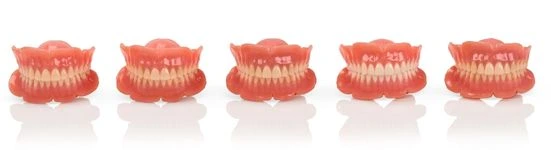
TrueDent from Stratasys is a useful example of how 3D printing can elevate the economy denture category. It is an FDA-cleared (Class II) and CE-marked (Class IIa) resin for dentures and temporary restorations designed for monolithic, polychromatic denture production on the J5 DentaJet platform. By printing the denture in a single structure, labs can eliminate bonding steps, streamline production, and support more consistent output.
For economy dentures specifically, the advantage is not simply lower upfront production cost. Digital workflows can also reduce manual labor, minimize assembly errors, improve repeatability, and simplify future remakes. TrueDent demonstrates how digital manufacturing can help labs produce scalable, aesthetic, repeatable dentures without turning economy-tier production into a labor bottleneck.
Traditional economy dentures generally offer the lowest upfront cost, but ongoing maintenance and replacement expenses can increase total long-term spending.
3D printed dentures may involve higher initial technology investment for labs, but digital workflows can reduce labor, remake rates, and production inefficiencies over time.
Traditional economy dentures rely heavily on manual craftsmanship and generic sizing, which can lead to inconsistent fit.
Digital dentures use CAD and digital scanning to improve accuracy and create more consistent patient outcomes.
Conventional dentures often require complete recreation if lost or damaged.
Digital dentures allow providers to reproduce archived designs more efficiently, simplifying denture replacement and reducing future chair time.
TrueDent is a monolithic, multi-color denture resin developed for use with Stratasys PolyJet technology. It enables simultaneous printing of denture bases and teeth in a single structure.
PolyJet technology deposits layers of photopolymer material with high precision, supporting detailed aesthetics and accurate fit.
This process also enables multicolor and shade-gradient capabilities that improve the natural appearance of digital dentures.
Unlike traditional workflows that require separate tooth bonding, monolithic printing combines the denture base and teeth into one printed structure.
This eliminates assembly steps and bonding-related failures.
The J5 DentaJet platform supports batch production workflows, allowing labs to manufacture dozens of dentures simultaneously with greater efficiency.
This scalability is especially valuable for high-volume labs producing economy-tier cases.
Digital workflows allow more predictable shade matching and aesthetic consistency across cases.
This enables exact reproducibility without needing manual characterization time.
TrueDent materials are FDA-cleared and CE-marked for specific intended dental applications and designed for biocompatibility, durability, and aesthetic performance. Modern denture resins are engineered to improve impact resistance, dimensional stability, and long-term appearance compared to some traditional cold-cured acrylic materials.


